WorldCat_Logo_V_Color You may remember my frustration a couple of months ago, at being in the air when OCLC announced the addition of Schema.org marked up Linked Data to all resources in WorldCat.org.   Those of you who attended the OCLC Linked Data Round Table at IFLA 2012 in Helsinki yesterday, will know that I got my own back on the folks who publish the press releases at OCLC, by announcing the next WorldCat step along the Linked Data road whilst they were still in bed.

The Round Table was an excellent very interactive session with Neil Wilson from the British Library, Emmanuelle Bermes from Centre Pompidou, and Martin Malmsten of the Nation Library of Sweden, which I will cover elsewhere.  For now, you will find my presentation Library Linked Data Progress on my SlideShare site.

After we experimentally added RDFa embedded linked data, using Schema.org markup and some proposed Library extensions, to WorldCat pages, one the most often questions I was asked was where can I get my hands on some of this raw data?

We are taking the application of linked data to WorldCat one step at a time so that we can learn from how people use and comment on it.  So at that time if you wanted to see the raw data the only way was to use a tool [such as the W3C RDFA 1.1 Distiller] to parse the data out of the pages, just as the search engines do.

So I am really pleased to announce that you can now download a significant chunk of that data as RDF triples.   Especially in experimental form, providing the whole lot as a download would have bit of a challenge, even just in disk space and bandwidth terms.  So which chunk to choose was a question.  We could have chosen a random selection, but decided instead to pick the most popular, in terms of holdings, resources in WorldCat – an interesting selection in it’s own right.

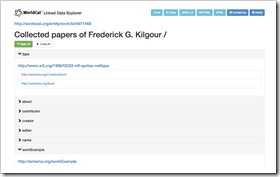
To make the cut, a resource had to be held by more than 250 libraries.  It turns out that almost 1.2 million fall in to this category, so a sizeable chunk indeed.   To get your hands on this data, download the 1Gb gzipped file. It is in RDF n-triples form, so you can take a look at the raw data in the file itself.  Better still, download and install a triplestore [such as 4Store], load up the approximately 80 million triples and practice some SPARQL on them.

Another area of question around the publication of WorldCat linked data, has been about licensing.   Both the RDFa embedded, and the download, data are published as open data under the Open Data Commons Attribution License (ODC-BY), with reference to the community norms put forward by the members of the OCLC cooperative who built WorldCat.  The theme of many of the questions have been along the lines of “I understand what the license says, but what does this mean for attribution in practice?

To help clarify how you might attribute ODC-BY licensed WorldCat, and other OCLC linked data, we have produced attribution guidelines to help clarify some of the uncertainties in this area.  You can find these at http://www.oclc.org/data/attribution.html.  They address several scenarios, from documents containing WorldCat derived information to referencing WorldCat URIs in your linked data triples, suggesting possible ways to attribute the OCLC WorldCat source of the data.   As guidelines, they obviously can not cover every possible situation which may require attribution, but hopefully they will cover most and be adapted to other similar ones.

As I say in the press release, posted after my announcement, we are really interested to see what people will do with this data.  So let us know, and if you have any comments on any aspect of its markup, schema.org extensions, publishing, or on our attribution guidelines, drop us a line at data@oclc.org.

Comment   or   Contact us

logo_wcmasthead_enTypical!  Since joining OCLC as Technology Evangelist, I have been preparing myself to be one of the first to blog about the release of linked data describing the hundreds of millions of bibliographic items in WorldCat.org. So where am I when the press release hits the net?  35,000 feet above the North Atlantic heading for LAX, that’s where – life just isn’t fair.

By the time I am checked in to my Anahiem hotel, ready for the ALA Conference, this will be old news.  Nevertheless it is significant news, significant in many ways.

OCLC have been at the leading edge of publishing bibliographic resources as linked data for several years.  At dewey.info they have been publishing the top levels of the Dewey classifications as linked data since 2009.  As announced yesterday, this has now been increased to encompass 32,000 terms, such as this one for the transits of Venus.  Also around for a few years is VIAF (the Virtual International Authorities File) where you will find URIs published for authors, such as this well known chap.  These two were more recently joined by FAST (Faceted Application of Subject Terminology), providing usefully applicable identifiers for Library of Congress Subject Headings and combinations thereof.

Despite this leading position in the sphere of linked bibliographic data, OCLC has attracted some criticism over the years for not biting the bullet and applying it to all the records in WorldCat.org as well.  As today’s announcement now demonstrates, they have taken their linked data enthusiasm to the heart of their rich, publicly available, bibliographic resources – publishing linked data descriptions for the hundreds of millions of items in WorldCat.

Let me dissect the announcement a bit….

Harry Potter and the Deathly Hallows (Book, 2007) [WorldCat.org] First significant bit of news – WorldCat.org is now publishing linked data for hundreds of millions of bibliographic items – that’s a heck of a lot of linked data by anyone’s measure. By far the largest linked bibliographic resource on the web. Also it is linked data describing things, that for decades librarians in tens of thousands of libraries all over the globe have been carefully cataloguing so that the rest of us can find out about them.  Just the sort of authoritative resources that will help stitch the emerging web of data together.

Second significant bit of news – the core vocabulary used to describe these bibliographic assets comes from schema.org.  Schema.org is the initiative backed by Google, Yahoo!, Microsoft, and Yandex, to provide a generic high-level vocabulary/ontology to help mark up structured data in web pages so that those organisations can recognise the things being described and improve the services they can offer around them.  A couple of examples being Rich Snippet results and inclusion in the Google Knowledge Graph.

As I reported a couple of weeks back, from the Semantic Tech & Business Conference, some 7-10% of indexed web pages already contain schema.org, microdata or RDFa, markup.   It may at first seem odd for a library organisation to use a generic web vocabulary to mark up it’s data – but just think who the consumers of this data are, and what vocabularies are they most likely to recognise?  Just for starters, embedding schema.org data in WorldCat.org pages immediately makes them understandable by the search engines, vastly increasing the findability of these items.

LinkedData Third significant bit of news – the linked data is published both in human readable form and in machine readable RDFa on the standard WorldCat.org detail pages.  You don’t need to go to a special version or interface to get at it, it is part of the normal interface. As you can see, from the screenshot of a WordCat.org item above, there is now a Linked Data section near the bottom of the page. Click and open up that section to see the linked data in human readable form.Harry Potter and the Deathly Hallows (Book, 2007) [WorldCat.org]-1  You will see the structured data that the search engines and other systems will get from parsing the RDFa encoded data, within the html that creates the page in your browser.  Not very pretty to human eyes I know, but just the kind of structured data that systems love.

Fourth significant bit of news – OCLC are proposing to cooperate with the library and wider web communities to extend Schema.org making it even more capable for describing library resources.  With the help of the W3C, Schema.org is working with several industry sectors to extend the vocabulary to be more capable in their domains – news, and e-commerce being a couple of already accepted examples.  OCLC is playing it’s part in doing this for the library sector.

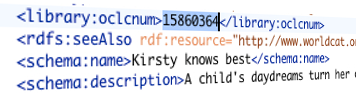
Harry Potter and the Deathly Hallows (Book, 2007) [WorldCat.org]-2 Take a closer look at the markup on WorldCat.org and you will see attributes from a library vocabulary.  Attributes such as library:holdingsCount and library:oclcnum.  This library vocabulary is OCLC’s conversation starter with which we want to kick off discussions with interested parties, from the library and other sectors, about proposing a basic extension to schema.org for library data.  What better way of testing out such a vocabulary –  markup several million records with it, publish them and see what the world makes of them.

Fifth significant bit of news – the WorldCat.org linked data is published under an Open Data Commons (ODC-BY) license, so it will be openly usable by many for many purposes.

Sixth significant bit of news – This release is an experimental release.  This is the start, not the end, of a process.  We know we have not got this right yet.  There are more steps to take around how we publish this data in ways in addition to RDFa markup embedded in page html – not everyone can, or will want to, parse pages to get the data.  There are obvious areas for discussion around the use of schema.org and the proposed library extension to it.  There are areas for discussion about the application of the ODC-BY license and attribution requirements it asks for.  Over the coming months OCLC wants to constructively engage with all that are interested in this process.  It is only with the help of the library and wider web communities that we can get it right.  In that way we can assure that WorldCat linked data can be beneficial for the OCLC membership, libraries in general, and a great resource on the emerging web of data.

For more information about this release, check out the background to linked data at OCLC, join the conversation on the OCLC Developer Network, or email data@oclc.org.

As you can probably tell I am fairly excited about this announcement.  This, and future stuff like it, are behind some of my reasons for joining OCLC.  I can’t wait to see how this evolves and develops over the coming months.  I am also looking forward to engaging in the discussions it triggers.

Comment   or   Contact us

Day three of the Semantic Tech & Business Conference in San Francisco brought us a panel to discuss Schema.org, populated by an impressive array of names and organisations:

IMG_0306 Ivan Herman, World Wide Web Consortium
Alexander Shubin, Yandex
Dan Brickley, Schema.org at Google
Evan Sandhaus, New York Times Company
Jeffrey W. Preston, Disney Interactive Media Group
Peter Mika, Yahoo!
R.V. Guha, Google
Steve Macbeth, Microsoft

This well attended panel started with a bit of a crisis – the stage in the room was not large enough to seat all of the participants causing a quick call out for bar seats and much microphone passing.  Somewhat reflective of the crisis of concern about the announcement of Schema.org, immediately prior to last year’s event which precipitated the hurried arrangement of a birds of a feather session to settle fears and disquiet in the semantic community.

Asking a fellow audience member what they thought of this session, they replied that the wasn’t much new said.  In my opinion I think that is a symptom of good things happening around the initiative.  He was right in saying that there was nothing substantive said, but there were some interesting pieces that came out of what the participants had to say.  Guha indicated that Google were already seeing that 7-10% of pages crawled already contained Schema.org mark-up, surprising growth in such a short time.  Steve Macbeth confirmed that Microsoft were also seeing around 7%.

Another unexpected but interesting insight from Microsoft was that they are looking to use Schema.org mark-up as a way to pass data between applications in Windows 8.  All the search engine folks were playing it close when asked what they were actually using the structured data they were capturing from Schema.org mark-up – lots of talk about projects around better search algorithms and indexing.  Guha, indicated that the Schema.org data was not siloed inside Google.  As with any other data it was used across the organisation, including within the Google Knowledge Graph functionality.

Jeffrey Preston responded to a question about the tangible benefits of applying Schema.org mark-up by describing how kids searching for games on the Disney site were being directed more accurately to the game as against pages that referenced it.  Evan Sandhaus described how it enabled a far easier integration with a vendor who could access their article data without having to work with a specific API.  Guha spoke about a Veterans job search site was created with the Department of Defence as they could constrain their search only to sites which only included Schema.org mark-up and identified jobs as appropriate for Veterans.

In questions from the floor, the panel explained the best way of introducing schema extensions, using the IPTC rNews as an example – get industry consensus to provide a well formed proposal and then be prepared to be flexible.   All done via the W3C hosted Public Vocabs List.

All good progress in only a year!

Richard Wallis is Technology Evangelist at OCLC and Founder of Data Liberate

Comment   or   Contact us

San Francisco So where have I been?   I announce that I am now working as a Technology Evangelist for the the library behemoth OCLC, and then promptly disappear.  The only excuse I have for deserting my followers is that I have been kind of busy getting my feet under the OCLC table, getting to know my new colleagues, the initiatives and projects they are engaged with, the longer term ambitions of the organisation, and of course the more mundane issues of getting my head around the IT, video conferencing, and expense claim procedures.

It was therefore great to find myself in San Francisco once again for the Semantic Tech & Business Conference (#SemTechBiz) for what promises to be a great program this year.  Apart from meeting old and new friends amongst those interested in the potential and benefits of the Semantic Web and Linked Data, I am hoping for a further step forward in the general understanding of how this potential can be realised to address real world challenges and opportunities.

As Paul Miller reported, the opening session contained an audience with 75% first time visitors.  Just like the cityscape vista presented to those attending the speakers reception yesterday on the 45th floor of the conference hotel, I hope these new visitors get a stunningly clear view of the landscape around them.

Of course I am doing my bit to help on this front by trying to cut through some of the more technical geek-speak. Tuesday 8:00am will find me in Imperial Room B presenting The Simple Power of the Link – a 30 minute introduction to Linked Data, it’s benefits and potential without the need to get you head around the more esoteric concepts of Linked Data such as triple stores, inference, ontology management etc.  I would not only recommend this session for an introduction for those new to the topic, but also for those well versed in the technology as a reminder that we sometimes miss the simple benefits when trying to promote our baby.

For those interested in the importance of these techniques and technologies to the world of Libraries Archives and Museums I would also recommend a panel that I am moderating on Wednesday at 3:30pm in Imperial B – Linked Data for Libraries Archives and Museums.  I will be joined by LOD-LAM community driver Jon Voss, Stanford Linked Data Workshop Report co-author Jerry Persons, and  Sung Hyuk Kim from the National Library of Korea.  As moderator I will, not only let the four of us make small presentations about what is happening in our worlds, I will be insistent that at least half the time will be there for questions from the floor, so bring them along!

I am not only surfacing at Semtech, I am beginning to see, at last, the technologies being discussed surfacing as mainstream.  We in the Semantic Web/Linked world are very good at frightening off those new to it.  However, driven by pragmatism in search of a business model and initiatives such as Schema.org, it is starting to become mainstream buy default.  One very small example being Yahoo’!s Peter Mika telling us, in the Semantic Search workshop, that RDFa is the predominant format for embedding structured data within web pages.

Looking forward to a great week, and soon more time to get back to blogging!

Comment   or   Contact us

200px-OCLC_logo.svg You may have noticed this press release Richard Wallis joins OCLC staff as Technology Evangelist today from OCLC.

I have already had some feedback on this move from several people, who almost without exception, have told me that they think it is good move for both OCLC and myself. Which is good, as I agree with them ;-)

I have also had several questions about it, mostly beginning with the words why or what.  My answers I thought I would share here to give some background.

Why a library organisation? – I thought you were trying to move away from libraries.
I have been associated with the library sector since joining BLCMP in 1990 to help them build a new library management system which they christened Talis.  As Talis, the company named after the library system, evolved and started to look at new Web influenced technologies to open up possibilities for managing and publishing library data, they and I naturally gravitated towards Semantic Web technologies and their pragmatic use in a way that became known as Linked Data.

Even though the Talis Group transferred their library division to Capita last year, that natural connection between library data and linked data principles meant that the association remained for me, despite having no direct connection with the development of the systems to run libraries.  Obvious examples of this were the Linked Data and Libraries events I ran in London with Talis and the work with the British Library to model and publish the British National Bibliography.  So even if I wanted to get away from libraries I believe it would be a fruitless quest, I think I am stuck with them!

Why OCLC? – Didn’t you spend a lot of time criticising them.
I can own up to several blog posts a few years back where I either criticised them for not being as open as I thought they could be, or questioning their business model at the time.  However I have always respected their mission to promote libraries and their evolution.   In my time chairing and hosting the Library 2.0 Gang, and in individual podcasts, I hope that I demonstrated a fairness that I always aspire towards, whilst not shying away from the difficult questions.   I have watched OCLC, and the library community they are part of, evolve over many years towards a position and vision that encompasses many of the information sharing principles and ambitions I hold.   In the very short amount of time I have already spent talking with my new colleagues it is clear that they are motivated towards making best use of data for the benefit of their members, libraries in general, and the people they serve – which is all of us.

Oh and yes, they have a great deal of data which has huge potential on the Linked Data Web and it will be great to be a part of realising at least some of that potential.

What about Data Liberate? – Are you going to continue with that.
I set up Data Liberate with a dual purpose.  Firstly, to promote myself as a consultant to help people and organisations realise the value in their data.  Secondly, to provide a forum and focus for sharing commenting upon, and discussing issues, ideas, events, and initiatives relevant to Open, Linked, Enterprise, and Big data.  Obviously the first of these is now not relevant, but I do intend to maintain Data Liberate to fulfil that second purpose.  I may not be posting quite as often, but I do intend to highlight and comment upon things of relevance in the broad landscape of data issues, regardless of if they are library focussed or not.

What are you going to be doing at OCLC?
My title is Technology Evangelist, and there is a great deal of evangelism needed – promoting, explaining, and demystifying the benefits of Linked Data to libraries and librarians.  This stuff is very new to a large proportion of the library sector, and not unsurprisingly there is some scepticism about it.  It would be easy to view announcements from organisations such as the British Library, Library of Congress, Europeana, Stanford University, OCLC, and many many more, as a general acceptance of a Linked Data library vision.  Far from it.  I am certain that a large proportion of librarians are not aware of the potential benefits of Linked Data for their world, or even why they should be aware.   So you will find me on stage at an increasing number of OCLC and wider library sector events, doing my bit to spread the word.

Like all technologies and techniques, Linked Data does not sit in isolation and there is obvious connections with the OCLC WorldShare Platform which is providing shared web based services for managing libraries and their data.  I will also be applying some time evangelising the benefits of this approach.

Aside from evangelising I will be working with people.  Working with the teams within OCLC as they coordinate and consolidate their approach to applying Linked Data principles across the organisation.  Working with them as they evolve the way OCLC will publish data to libraries and the wider world.  Working with libraries to gain their feedback.  Working with the Linked Data and Semantic Web community to gain feedback as to the way to publish that data in a way that not only serves the library community, but also to all across the emerging Web of Data.  So you will continue to find me on stage at events such as the Semantic Tech and Business Conference, doing my bit to spread the word, as well as engaging directly with the community.

Why libraries? – Aren’t they a bit of a Linked Data niche.
I believe that there are two basic sorts of data being published on the [Linked Data] web – backbone data and the non-backbone data the value of which is greatly increased by linking to the backbone.

By backbone data I mean things like: Dbpeadia with it’s identifier for most every ‘thing’; government data with authoritative identifiers for laws, departments, schools, etc.; mapping organisations, such as Ordnance Survey with authoritative identifiers for post codes etc.  By linking your dataset’s concepts to these backbone sources, you immediately increase its usefulness and ability to link and merge with other data linked in the same way.  I believe that the descriptions of our heritage and achievements both scientific and artistic, held by organisations such as our national, academic, and public libraries is a massive resource that has the opportunity to form a very significant vertebrae on that backbone.

Hopefully some of the above will help in the understanding of the background and motivations behind this new and exciting phase of my career.  These opinions and ambitions for the evolution of data on the web, and in the enterprise, are all obviously mine, so do not read in to them any future policy decisions or directions for my new employer.  Suffice to say I will not be leaving them at the door. Neither will I cast off my approach to pragmatically solving problems in the real world by evolving towards a solution recognising that the definition of the ideal changes over time and with circumstance.

Comment   or   Contact us

democracy Two, on the surface, totally unconnected posts – yet the the same message.  Well that’s how they seem to me anyway.

Post 1The Problem With Wikidata from Mark Graham writing in the Atlantic.

wikimedia When I reported the announcement of Wikidata by Denny Vrandecic at the Semantic Tech & Business Conference in Berlin in February,  I was impressed with the ambition to bring together all the facts from all the different language versions of Wikipedia in a central Wikidata instance with a single page per entity. These single pages will draw together all references to the entities and engage with a sustainable community to manage this machine-readable resource.   This data would then be used to populate the info-boxes of all versions of Wikipedia in addition to being an open resource of structured data for all.

In his post Mark raises concerns that this approach could result in the loss of the diversity of opinion currently found in the diverse Wikipedias:

It is important that different communities are able to create and reproduce different truths and worldviews. And while certain truths are universal (Tokyo is described as a capital city in every language version that includes an article about Japan), others are more messy and unclear (e.g. should the population of Israel include occupied and contested territories?).

He also highlights issues about the unevenness or bias of contributors to Wikipedia:

We know that Wikipedia is a highly uneven platform. We know that not only is there not a lot of content created from the developing world, but there also isn’t a lot of content created about the developing world. And we also, even within the developed world, a majority of edits are still made by a small core of (largely young, white, male, and well-educated) people. For instance, there are more edits that originate in Hong Kong than all of Africa combined; and there are many times more edits to the English-language article about child birth by men than women.

A simplistic view of what Wikidata is attempting to do could be a majority-rules filter on what is correct data, where low volume opinions are drowned out by that majority.  If Wikidata is successful in it’s aims, it will not only become the single source for info-box data in all versions of Wilkipedia, but it will take over the mantle currently held by Dbpedia as the de faco link-to place for identifiers and associated data on the Web of Data and the wider Web.

I share some of his concerns, but also draw comfort from some of the things Denny said in Berlin –  “WikiData will not define the truth, it will collect the references to the data….  WikiData created articles on a topic will point to the relevant Wikipedia articles in all languages.”  They obviously intend to capture facts described in different languages, the question is will they also preserve the local differences in assertion.  In a world where we still can not totally agree on the height of our tallest mountain, we must be able to take account of and report differences of opinion.

Post 2Danbri has moved on – should we follow? by a former colleague Phil Archer.

schema-org1 The Danbri in question is Dan Brickley, one of the original architects of the Semantic Web, now working for Google in Schema.org.  Dan presented at an excellent Semantic Web Meetup, which I attended at the BBC Academy a couple of weeks back.  This was a great event.  I recommend investing in the time to watch the videos of Dan and all the other speakers.

Phil picked out a section of Dan’s presentation for comment:

In the RDF community, in the Semantic Web community, we’re kind of polite, possibly too polite, and we always try to re-use each other’s stuff. So each schema maybe has 20 or 30 terms, and… schema.org has been criticised as maybe a bit rude, because it does a lot more it’s got 300 classes, 300 properties but that makes things radically simpler for people deploying it. And that’s frankly what we care about right now, getting the stuff out there. But we also care about having attachment points to other things…

Then reflecting on current practice in Linked Data he went on to postulate:

… best practice for the RDF community…  …i.e. look at existing vocabularies, particularly ones that are already widely used and stable, and re-use as much as you can. Dublin Core, FOAF – you know the ones to use.

Except schema.org doesn’t.

schema.org has its own term for name, family name and given name which I chose not to use at least partly out of long term loyalty to Dan. But should that affect me? Or you? Is it time to put emotional attachments aside and move on from some of the old vocabularies and at least consider putting more effort into creating a single big vocabulary that covers most things with specialised vocabularies to handle the long tail?

As the question in the title of his post implies, should we move on and start adopting, where applicable, terms from the large and extending Schema.org vocabulary when modelling and publishing our data.  Or should we stick with the current collection of terms from suitable smaller vocabularies.

One of the common issues when people first get to grips with creating Linked Data is what terms from which vocabularies do I use for my data, and where do I find out.  I have watched the frown skip across several people’s faces when you first tell them that foaf:name is a good attribute to use for a person’s name in a data set that has nothing to do with friends or friends of friends. It is very similar to the one they give you when you suggest that it may also be good for something that isn’t even a person.

As Schema.org grows and, enticed by the obvious SEO benefits in the form of Rich Snippets, becomes rapidly adopted by a community far greater than the Semantic Web and Linked Data communities, why would you not default to using terms in their vocabulary?   Another former colleague, David Wood Tweeted  No in answer to Phil’s question – I think this in retrospect may seem a King Canute style proclamation.  If my predictions are correct, it won’t be too long before we are up to our ears in structured data on the web, most of it marked up using terms to be found at schema.org.

You may think that I am advocating the death, and replacement by Schema.org, of all the vocabularies well known, and obscure, in use today – far from it.   When modelling your [Linked] data, start by using terms that have been used before, then build on terms more specific to your domain and finally you may have to create your own vocabulary/ontology.  What I am saying is that as Schema.org becomes established, it’s growing collection of 300+ terms will become the obvious start point in that process.

OK a couple of interesting posts, but where is the similar message and connection?  I see it as democracy of opinion.  Not the democracy of the modern western political system, where we have a stand up shouting match every few years followed by a fairly stable period where the rules are enforced by one view.  More the traditional, possibly romanticised, view of democracy where the majority leads the way but without disregarding the opinions of the few.  Was it the French Enlightenment philosopher Voltaire who said: ”I may hate your views, but I am willing to lay down my life for your right to express them” – a bit extreme when discussing data and ontologies, but the spirit is right.

Once the majority of general data on the web becomes marked up as schema.org – it would be short sighted to ignore the gravitational force it will exert in the web of data if you want your data to be linked to and found.  However, it will be incumbent on those behind Schema.org to maintain their ambition to deliver easy linking to more specialised vocabularies via their extension points.  This way the ‘how’ of data publishing should become simpler, more widespread, and extensible.   On the ‘what’ side of the the [structured] data publishing equation, the Wikidata team has an equal responsible to not only publish the majority definition of facts, but also clearly reflect the views of minorities – not a simple balancing act as often those with the more extreme views have the loudest voices.

Main image via democracy.org.au.
Comment   or   Contact us

IMG_0256 So I need to hang up some tools in my shed.  I need some bent hook things – I think.  Off to the hardware store in which I search for the fixings section.  Following the signs hanging from the roof, my search is soon directed to a rack covered in lots of individual packets and I spot the thing I am looking for, but what’s this – they come in lots of different sizes.  After a bit of localised searching I grab the size I need, but wait – in the next rack there are some specialised tool hanging devices.  Square hooks, long hooks, double-prong hooks, spring clips, an amazing choice!  Pleased with what I discovered and selected I’m soon heading down the isle when my attention is drawn to a display of shelving with hidden brackets – just the thing for under the TV in the lounge.  I grab one of those and head for the checkout before my credit card regrets me discovering anything else.

We all know the library ‘browse’ experience.  Head for a particular book, and come away with a different one on the same topic that just happened to be on a nearby shelf, or even a totally different one that you ‘found’ on the recently returned books shelf.

An ambition for the web is to reflect and assist what we humans do in the real world.  Search has only brought us part of the way. By identifying key words in web page text, and links between those pages, it makes a reasonable stab at identifying things that might be related to the keywords we enter.

As I commented recently, Semantic Search messages coming from Google indicate that they are taking significant steps towards the ambition.   By harvesting Schema.org described metadata embedded in html, by webmasters enticed by Rich Snippets, and building on the 12 million entity descriptions in Freebase they are amassing the fuel for a better search engine.  A search engine [that] will better match search queries with a database containing hundreds of millions of “entities”—people, places and things.

How much closer will this better, semantic, search get to being able to replicate online the scenario I shared at the start of this post.  It should do a better job of relating our keywords to the things that would be of interest, not just the pages about them.  Having a better understanding of entities should help with the Paris Hilton problem, or at least help us navigate around such issues.  That better understanding of entities, and related entities, should enable the return of related relevant results that did not contain our keywords.

But surely there is more to it than that.  Yes there is, but it is not search – it is discovery.  As in my scenario above, humans do not only search for things.  We search to get ourselves to a start point for discovery.  I searched for an item in the fixings section in the hardware store or a book in the the library I then inspected related items on the rack and the shelf to discover if there was anything more appropriate for my needs nearby.  By understanding things and the [semantic] relationships between them, systems could help us with that discovery phase. It is the search engine’s job to expose those relationships but the prime benefit will emerge when the source web sites start doing it too.

BBC Nature - Aardvark videos, news and facts Take what is still one of my favourite sites – BBC wildlife.  Take a look at the Lion page, found by searching for lions in Google. Scroll down a bit and you will see listed the lion’s habitats and behaviours.  These are all things or concepts related to the lion.  Follow the link to the flooded grassland habitat, where you will find lists of flora and fauna that you will find there, including the aardvark which is nocturnal.  Such follow-your-nose navigation around the site supports the discovery method of finding things that I describe.  In such an environment serendipity is only a few clicks away.

There are two sides to the finding stuff coin – Search and Discovery.  Humans naturally do both, systems and the web are only just starting to move beyond search only.  This move is being enabled by the constantly growing data that is describing things and their relationships – Linked Data.  A growth stimulated by initiatives such as Schema.org, and Google providing quick return incentives, such as Rich Snippets & SEO goodness, for folks to publish structured data for reasons other than a futuristic Semantic Web.

Comment   or   Contact us

GoogleBlueBalls Today’s Wall Street Journal gives us an insight in to the makeover underway in the Google search department.

Over the next few months, Google’s search engine will begin spitting out more than a list of blue Web links. It will also present more facts and direct answers to queries at the top of the search-results page.

They are going about this by developing the search engine [that] will better match search queries with a database containing hundreds of millions of “entities”—people, places and things—which the company has quietly amassed in the past two years.

The ‘amassing’ got a kick start in 2010 with the Metaweb acquisition that brought Freebase and it’s 12 Million entities into the Google fold.  This is now continuing with harvesting of html embedded, schema.org encoded, structured data that is starting to spread across the web.

The encouragement for webmasters and SEO folks to go to the trouble of inserting this information in to their html is the prospect of a better result display for their page – Rich Snippets.  A nice trade-off from Google – you embed the information we want/need for a better search and we will give you  better results.

The premise of what Google are are up to is that it will deliver better search.  Yes this should be true, however I would suggest that the major benefit to us mortal Googlers will be better results.  The search engine should appear to have greater intuition as to what we are looking for, but what we also should get is more information about the things that it finds for us.  This is the step-change.  We will be getting, in addition to web page links, information about things – the location, altitude, average temperature or salt content of a lake. Whereas today you would only get links to the lake’s visitors centre or a Wikipedia page.

Another example quoted in the article:

…people who search for a particular novelist like Ernest Hemingway could, under the new system, find a list of the author’s books they could browse through and information pages about other related authors or books, according to people familiar with the company’s plans. Presumably Google could suggest books to buy, too.

Many in the library community may note this with scepticism, and as being a too simplistic approach to something that they have been striving towards for for many years with only limited success.  I would say that they should be helping the search engine supplier(s) do this right and be part of the process.  There is great danger that, for better or worse, whatever Google does will make the library search interface irrelevant.

As an advocate for linked data, it is great to see the benefits of defining entities and describing the relationships between them being taken seriously.   I’m not sure I buy into the term ‘Semantic Search’ as a name for what will result.  I tend more towards ‘Semantic Discovery’ which is more descriptive of where the semantics kick in – in the relationship between a searched for thing and it’s attributes and other entities.  However I’ve been around far too long to get hung up about labels.

Whilst we are on the topic of labels, I am in danger of stepping in to the almost religious debate about the relative merits of microdata and RDFa as the encoding method for embedding the schema.org.  Google recognises both, both are ugly for humans to hand code, and web masters should not have to care.  Once the CMS suppliers get up to speed in supplying the modules to automatically embed this stuff, as per this Drupal module, they won’t have to care.

I welcome this.  Yet it is only a symptom of something much bigger and game-changing as I postulated last month A Data 7th Wave is Approaching.

Comment   or   Contact us